Monday, September 11, 2023
Smell & Tell Event | AI, Machine Learning and Smells!
Saturday, September 9, 2023
Smell & Tell Event | Inside the Olfactory Mind of Steffen Arctander
![]() |
| Mark your calendars! Steffen Arctander is the focus of an upcoming Smell & Tell at the Ann Arbor District Library. |
Friday, September 9, 2022
Birthday of Note: Steffen Arctander, Perfumer and Flavorist (September 9)
Steffen Arctander was born in Denmark on September 9, 1919. He is best known as the author of Perfume and Flavor Materials of Natural Origin, which was independently published in 1960. His birthday is the perfect time to reflect on his unique and atypical career.
Arctander was one of the founders of the Society of Cosmetic Chemists of Denmark (Dansk Kosmetic-Kemisk Selskab) in 1955, when he was chief chemist and perfumer at Co-Ro Manufacturing (the company was focused on flavor essences for mineral water and ice cream during his tenure there).
He moved to the United States two years later to join the perfume and essential oils division of the Colgate-Palmolive Company. He created the first college-level course in perfumery at Rutgers University the same year (1957). Rutgers currently offers four courses (master's degree level) related to fragrance and personal care, which is a testament to Steffen Arctander's legacy.
The formation of International Flavors and Fragrances (IFF) (the result of a merger between Polak and Schwarz, and Van Amerigen and Haebler in 1958) led to Arctander's role as perfumer and head of the odor quality control department at IFF in 1960.
Four years later, Steffen Arctander was a contestant on To Tell the Truth, a popular game show that aired on WCBS-TV and taped in New York City. It was the closest Arctander got to fame as a member of the highly secretive flavor and fragrance industry. He was working for IFF at the time.
Arctander's success was shaped by interdisciplinary and autodidactic qualities that magnified his life's purpose on and off the lab bench. He could work on a mint toothpaste formula with the same interest, skill and finesse that he applied to the creation of Blue Diamond perfume* (a personal project).
Job titles have a way of confining accomplished employees with more than one area of scientific expertise. It's hard to imagine this wasn't the case for Arctander. He understood and applied what it took to create a chemically balanced fine fragrance (perfume), a functional fragrance (e.g. scent used in soap, lotion, detergent) and a functional flavorant (e.g. beverages, toothpaste, extracts).
What consumer products possessed the mark of his fragrant and flavorful handiwork? We'll never know or infer, as non-disclosure agreements are a permanent roadblock.
Arctander's expertise in natural raw materials and chemistry allowed him to work across product types and by extension, disciplines. Hands-on experience in the field and the lab gave him latitude in his professional life, and a meaningful legacy after he died on October 29, 1982.
Perfume and Flavor Materials of Natural Origin is more than a well-researched handbook; it's the essence of Steffen Arctander and as close as the reader will get to his biography. This is evident in content that bookends the monographs on natural raw materials.
The beginning and end of the book is where the reader learns about the author's approach to fragrance creation and categorization, as well as international travel focused on existing and novel aromatic ingredients. The travel portion is scientifically informed, diaristic fieldwork.
Happy Birthday, Steffen Arctander. Perhaps we'll know more about you on the anniversary of your birthday in 2023. We have history and memories for now.
Notes & Curiosities:
The image of Steffen Arctander that accompanies this post is from Volume 8, Number 3 edition of the Journal of Cosmetic Science. The journal was published in 1957 and includes a wonderful article about Florence E. Wall, an award-winning female chemist.
Steffen Arctander joined the British Intelligence Service during WWII, where he applied chemical expertise in explosives against the Nazis.
*Steffen Arctander formulated a perfume called Blue Diamond that was released in 1979. There is little of it in circulation. An experiential account of its olfactory qualities is revealed in perfumer Ayala Moriel's Smelly Blog. BTW: Elizabeth Taylor's White Diamonds (perfumer Carlos Benaim, IFF) was released in 1991 and isn't related to Arctander's perfume.
Monday, March 7, 2022
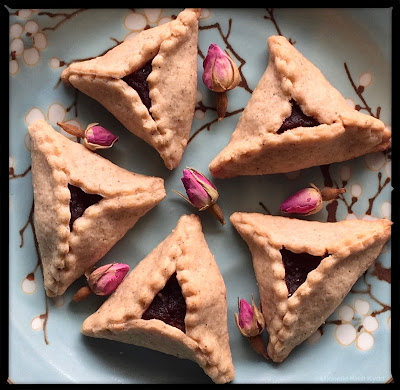
Baking with Flavor: Spiced Rose Hamantaschen
- 2 cups unbleached, all-purpose flour (sifted)*
- 2 tsp double-acting baking powder (aluminum-free)
- 1/4 tsp sea salt (fine ground)
- 3/4 cup granulated sugar
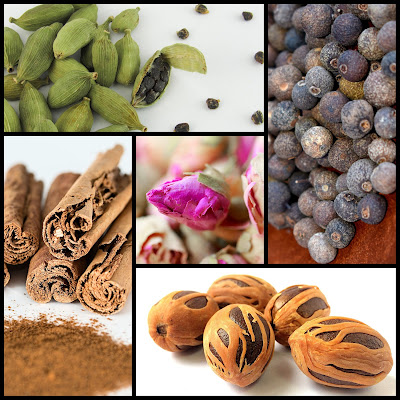
- 2 tsp Pereg Mixed Spices for Koobah
- 1 stick of cold, unsalted butter
- 1 large egg
- 1 tsp almond extract
- 1 tsp Eden Botanicals Organic Rose Hydrosol (or 1/4 tsp of a commercial brand like Cortas as it's very strong)
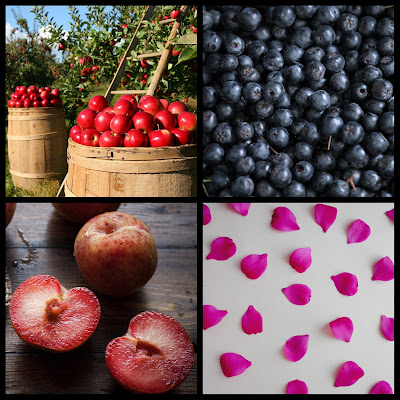
- 1 jar of Cracovia Rose Hip Lekvar
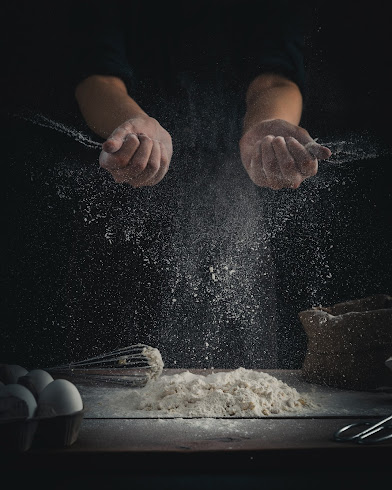
- Sift the flour, baking powder, salt, sugar and Koobah spice into a large mixing bowl.
- In a small bowl, beat the egg with almond extract and rosewater. Set aside.
- Cut the stick of butter into small cubes by cutting horizontally, then vertically. Add cubed butter to the dry ingredients and coat them. Press the cubed pieces of butter flat to form petals. Combine the butter petals with the dry ingredients until the mixture resembles coarse crumbs.
- Make a well in the center of the bowl with the dry ingredients and add the wet ingredients. Mix the dough with your hands until it is completely moistened. Gently work it in the bowl and form a single mound of dough that holds together well (it will feel less cohesive than typical cookie dough, which changes after refrigeration).
- Separate the single mound into two mounds of equal weight. Wrap each one in plastic wrap and place them side by side in a gallon-sized plastic bag with a zip seal. Refrigerate the dough overnight for a minimum of six hours to a maximum of 18 hours (longer is better for flavor).
- Line two cookie trays with parchment paper when the dough is ready to use. Set aside.
- Work with one half of a mound of refrigerated dough at a time, keeping the other half refrigerated.
- Roll the dough into an even 1/8-inch thickness on a pastry mat, working quickly as the dough tends to be sticky (short quick rolling helps).
- Cut the dough into rounds with a plain or scalloped 3-inch cookie cutter. You’ll fill the dough and shape it after you cut 7 rounds. (Each half a pastry mound yields approximately 7 cookies).
- Move the rounds to a parchment-lined cookie sheet using a long confection spatula (a small, flat silicone cookie spatula will also work as it's flexible).
- Scoop a teaspoon of the filling using a one-teaspoon measuring spoon, removing the excess filling from the bottom of the measuring spoon (a form of leveling) and adding the excess filling back into the jar.
- Place the leveled filling into the center of each round using an additional spoon to scoop it out.
- Make a triangle shape by folding up two sides of the dough (each side is equivalent to a third of the circle) and pinch the corners together where they meet.
- Fold up the third side and pinch together at both sides, forming a triangle and leaving an opening at the top (don't close the center). The filling should be just above the top of the pastry.
- Continue rolling, cutting, filling and shaping the dough rounds until you've finished using all of the refrigerated dough.
- Adjust the arrangement of hamantaschen so that each one is 1 1/2 inches apart (1 inch for cookies made with a 2 3/4 inch pastry cutter) when you're done. Take advantage of the geometry of the cookie, as triangular shapes can be placed at different angles without touching while baking.
- Divide the oven racks into thirds and preheat the oven to 375 degrees.
- Bake for 12 minutes, reversing sheets from top to bottom and back to front after the first 6 minutes. The cookies should be barely colored on the sides, slightly darker on the edges. Add 1-2 minutes if needed, based on the temperament of your oven.
- Move the baked hamantaschen to cooling racks and allow them to them cool completely. Store them in an airtight container between layers of parchment paper for 24 hours before eating. The resting period allows the flavors to meld.