Showing posts with label Rose. Show all posts

Monday, March 7, 2022

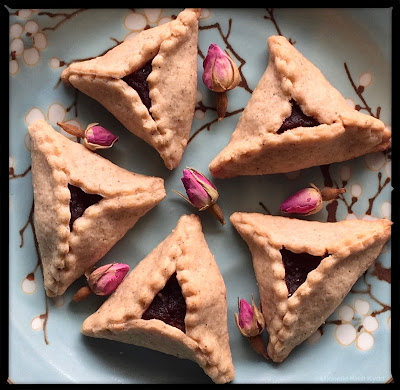
Baking with Flavor: Spiced Rose Hamantaschen

Bronx bakeries of my youth sold large, unruly hamantaschen. Eating them was a war between front teeth and a solid wall of dry cookie dough that cracked and crumbled with every bite. Elastic textures of apricot, prune and poppy seed filling offered little reward for the effort it took to get to the center of the triangular-shaped pastry. Taking a bite out of the holiday cookie eaten on Purim symbolizes victory over Haman in the Book of Esther. The only thing my friends and I tasted when we ate bakery hamantaschen was irony.

No one should sacrifice teeth or good taste for the sake of eating hamantaschen. Buying one from a bakery is still a gamble to which the offense of preposterous fillings and decorations can be added. What can a person who craves descent tasting hamantaschen do?  

The solution is making butter-based hamantaschen from scratch. Butter supports a light flakey texture in the pastry. Shortening and excess sugar are key offenders in bad bakery hamantaschen (they're responsible for hard textures in pastry that taste of nothingness). Does the thought of tender-at-the-bite hamantaschen make your mouth water and whisking wrist tremble? Just wait until you work the aromatic dough with your hands when you make Spiced Rose Hamantaschen (it's a textural hybrid of piecrust and shortbread).

Hamantaschen dough deserves more attention as a flavor source versus a neutral foundation for pastry filling. Citrus zest and vanilla are used to flavor the dough in traditional hamantaschen. Quality fruit fillings are hard to come by, so it's not uncommon for bakers to make their own by cooking dried plums (prunes) or apricots with sugar and water. The finished product is a concentrated fruit butter called lekvar. The balance of citrus zest and vanilla used in the dough complements the flavor profile of tart stone fruits. 

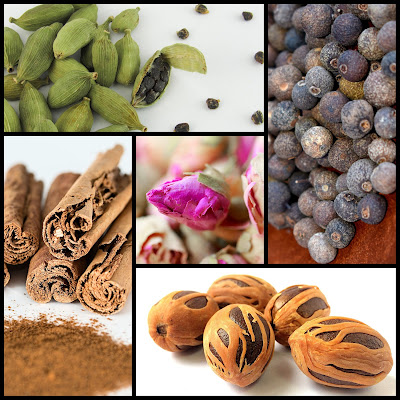
The recipe for Spiced Rose Hamantaschen follows the style of complementary flavor support in traditional hamantaschen—with a twist. Cinnamon, dried rosebuds, allspice, nutmeg and cardamom (Pereg Mixed Spices for Koobah) are added to the dry ingredients in the recipe. Almond extract and Eden Botanicals Organic Rose Hydrosol (a food grade distillate of essential oil of rose) are whisked into the egg mixture. The unique combination of flavors in the dough is a nod to Mizrahi and Sephardic baking traditions. 
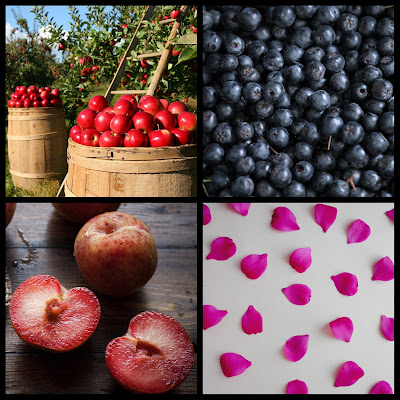


Rose isn't an outlier when it comes to flavor. Like apricot, plum and other stone fruits, the rose is a member of the Rosa genus of plants in the family of Rosacea. Edible seed-bearing fruit from various rose species are called rose hips. They have a tart, fruity flavor profile versus fresh rose petals, which taste like roses smell. Dried pink rose petals have a bright spicy floral character with nuances of delicate citrus. Dried red rose petals have an earthy-musky, fruity-floral flavor profile with a touch of warm spice. 

Cracovia Rose Hip Lekvar is an exquisite filling used in Spiced Rose Hamantaschen. The imported Polish lekvar is a popular filling for paczki (donuts) and kolaczki (cookies), which is why it's easy to find at local Polish food shops across the country. The ingredient list includes: apples, plums, chokeberries and rose flavor (the latter possesses an exquisite citrus-floral quality that's similar to the character of rose aroma in Eden Botanicals Organic Rose Hydrosol, which is made from pink Rosa damascena flowers). 
Recipe Origin & Adaptation for Spiced Rose Hamantaschen

Spiced Rose Hamantaschen is an adaptation of a hamantaschen recipe in Maida Heatter's Cookies (Andrews McMeel Publishing, 1997). I've changed the flavor structure and edited the instructions. Anyone using this recipe may increase the number of cookies by using a 2.75 inch pastry cutter (48 cookies give or take). The single jar of rose hip lekvar will work for both cookie yields as long as the filling is leveled before being placed on the dough rounds (you won't need more because it's packed with flavor).

The baking temperature is reduced from 400 degrees to 375 degrees for optimal pastry texture (you can always increase time based on oven temperament or bake at 400 degrees). Forming hamantaschen on parchment-lined cookie trays after cutting rounds on a pastry mat replaces instructions to form pastry in hand (the latter doesn't work). Using all-purpose flour with too much protein will cause the dough to fall apart when you form hamantaschen and it can't be remedied. Guidance regarding flour protein content is included below the ingredients list. A mixer isn't needed for this recipe.

Spiced Rose Hamantaschen
Recipe by Maida Heatter
Flavor Development/Instruction Modification by Michelle Krell Kydd
Yield: 27 cookies

Ingredients 
*Be sure to use unbleached all-purpose flour that contains 3g of protein per 1/4 cup serving of flour. Some all-purpose flours have upwards of 3g of protein per serving, and hamantaschen pastry dough will not hold together at high levels of protein. Read the nutrition label on the bag of flour to ensure baking success.

Instructions 
  • Sift the flour, baking powder, salt, sugar and Koobah spice into a large mixing bowl. 
  • In a small bowl, beat the egg with almond extract and rosewater. Set aside.
  • Cut the stick of butter into small cubes by cutting horizontally, then vertically. Add cubed butter to the dry ingredients and coat them. Press the cubed pieces of butter flat to form petals. Combine the butter petals with the dry ingredients until the mixture resembles coarse crumbs. 
  • Make a well in the center of the bowl with the dry ingredients and add the wet ingredients. Mix the dough with your hands until it is completely moistened. Gently work it in the bowl and form a single mound of dough that holds together well (it will feel less cohesive than typical cookie dough, which changes after refrigeration). 
  • Separate the single mound into two mounds of equal weight. Wrap each one in plastic wrap and place them side by side in a gallon-sized plastic bag with a zip seal. Refrigerate the dough overnight for a minimum of six hours to a maximum of 18 hours (longer is better for flavor).
  • Line two cookie trays with parchment paper when the dough is ready to use. Set aside.
  • Work with one half of a mound of refrigerated dough at a time, keeping the other half refrigerated. 
  • Roll the dough into an even 1/8-inch thickness on a pastry mat, working quickly as the dough tends to be sticky (short quick rolling helps). 
  • Cut the dough into rounds with a plain or scalloped 3-inch cookie cutter. You’ll fill the dough and shape it after you cut 7 rounds. (Each half a pastry mound yields approximately 7 cookies). 
  • Move the rounds to a parchment-lined cookie sheet using a long confection spatula (a small, flat silicone cookie spatula will also work as it's flexible). 
  • Scoop a teaspoon of the filling using a one-teaspoon measuring spoon, removing the excess filling from the bottom of the measuring spoon (a form of leveling) and adding the excess filling back into the jar. 
  • Place the leveled filling into the center of each round using an additional spoon to scoop it out.
  • Make a triangle shape by folding up two sides of the dough (each side is equivalent to a third of the circle) and pinch the corners together where they meet. 
  • Fold up the third side and pinch together at both sides, forming a triangle and leaving an opening at the top (don't close the center). The filling should be just above the top of the pastry. 
  • Continue rolling, cutting, filling and shaping the dough rounds until you've finished using all of the refrigerated dough.
  • Adjust the arrangement of hamantaschen so that each one is 1 1/2 inches apart (1 inch for cookies made with a 2 3/4 inch pastry cutter) when you're done. Take advantage of the geometry of the cookie, as triangular shapes can be placed at different angles without touching while baking.
  • Divide the oven racks into thirds and preheat the oven to 375 degrees. 
  • Bake for 12 minutes, reversing sheets from top to bottom and back to front after the first 6 minutes. The cookies should be barely colored on the sides, slightly darker on the edges. Add 1-2 minutes if needed, based on the temperament of your oven.
  • Move the baked hamantaschen to cooling racks and allow them to them cool completely. Store them in an airtight container between layers of parchment paper for 24 hours before eating. The resting period allows the flavors to meld. 
Creating memorable flavor combinations requires patience and imagination. You never know what can happen when you find an ingredient that inspires you. Case in point. Food writer Heather Eddy fell in love with the lemon-vanilla-orange blossom bouquet in Fiori di Sicilia. She liked it so much she decided to wear the flavor extract as perfume because it's made of food grade essential oils. If this rings your hamantaschen bell here's a little inspiration for you. Fiori di Sicilia is an olfactory cousin of Eau de Cologne. Imagine what Fiori di Sicilia infused hamantaschen dough filled with bergamot marmalade or lemon curd would taste like. 

Notes & Musings
Pereg Mixed Spices for Koobah is available online at Pereg Gourmet ($8.60 for 3.5 oz). The spice mix can be used in savory and sweet applications. If you'd like to substitute a variation of the spice blend that you can make at home, follow the proportions in the ingredient listing for Koobah located in the fifth paragraph of this post. Be sure to use Ceylon cinnamon as that is the type used in the spice mix. Organic pink rosebuds can be purchased from online spice shops. You'll have to separate the petals from the stem at the base, which is a lovely thing to do. 

Eden Botanicals Organic Rose Hydrosol is available online at Eden Botanicals. The recommended purchase size is 4 ounces ($14.00) as it needs to be refrigerated after opening. Rose hydrosol can be used to flavor coffee, tea or hot chocolate. (It also makes a great face toner and is lovely when sprayed on bed sheets before going to sleep, so go up a size if it's something that appeals to you.) 

Cracovia Rose Hip Lekvar is available online at the Polish Art Center in Hamtramck, Michigan. It's fresh and competitively priced ($3.80 for a 12.34 oz jar). Note to sharp-eyed readers of ingredient labels: rose hips aren't listed on the jar of Polish rose hip lekvar. This is permitted by European Union regulations when the amount of a specific fruit in a mixed fruit jam is under 2%.  

Jam is thinner than preserves, and has a tendency to leak out of the hamantaschen pastry while it's baking. If you choose preserves for your hamantaschen recipe make sure that pectin is included in the ingredient list (it’s a natural fruit-based gelling agent).

The best rose preserves are made with sugar, rose petals, lemon juice and pectin, but they lack the thickness required for hamantaschen filling (they'll weep in the oven). If you're a determined experimenter, hack a jar of Maharishi Ayurveda brand Organic Rose Petal Spread and turn it into lekvar with other ingredients.

Photo of Spiced Rose Hamantaschen on a plate by Michelle Krell Kydd. All rights reserved. Ingredient image collages created with various Creative Commons photos from Pixabay. Image of person pouring flour on a table by Mae Mu on Unsplash.

Monday, February 1, 2021

Love Potion No. 99: An Aphrodisiac Elixir for the Senses

Love potion. The very notion tastes like alchemy, dry ice and witchery. The concept of food as a talisman isn't new, but when it's attached to love there seems to be an unending string of incarnations.    

Every act of coupling has a unique quality and whether or not it is intended, the potential for creating new life is written into the physical expression of affection. In that tide of energy, identities are exchanged, traded and temporarily obliterated. 

Each person emerges slightly different, yet more themselves than they were before. How could one not try to pierce that mystery by engaging the sense of taste?

Say the phrase “love potion” to Chef Susan Baldassano and she recollects her days at Angelica Kitchen, where the staff and the patrons partook of a mysterious brew called Love Potion No. 99. 

The name pays tribute to aphrodisiac elixirs and brews with flavors shaped by warm spices, as well as fruits, herbs and spices with hints of aldehydic qualities. 

It isn't difficult to imagine perfumer Ernest Beaux taking a break from playing with aldehyde molecules while formulating Chanel No. 5, and partaking of Love Potion No. 99 when he was off the lab bench. 

The intention of the elixir has nothing to do with the scent of freshly scrubbed skin that inspired Chanel No. 5. It's a complementary contrast, which is as it should be. 

Ingredients
  • 6 cups apple or pomegranate juice 
  • 2 cups water 2 tablespoons sugar/honey 
  • 1 oz. (30g) rose petals (food grade) or 1-2 tsp rosewater 
  • 1 stick Ceylon cinnamon (Cinnamomum vera)
  • ¼ oz. (7g) lavender blossoms (food grade) 
  • ¼ oz. (7g) whole nutmeg 
  • ¼ oz. (7g) whole Ceylon cloves  
  • ¼ oz. (7g) candied ginger 
Optional additions (highly recommended): 
  • 2 whole star anise 
  • ¼ tsp. orange peel 
  • ¼ vanilla bean or 1 tsp vanilla extract 
Instructions:
  • Simmer juice, water and sweetener. Do not boil as this will produce cloudiness. 
  • Put all herbs and spices in a cheesecloth and steep for seven minutes. 
  • Remove from heat. 
  • Strain liquid from the cheesecloth to extract the flavors. 
  • Serve warm or refrigerate. 
Notes: 
Chef Susan Baldassano, a graduate of the New York Institute for Culinary Education, has been a cooking instructor for over 30 years. She also served as Director of Education at the Natural Gourmet Institute for Health and Culinary Arts, in New York City. 

Chanel No. 5 is famous for its sparkling aldehydic qualities. If you're a Chanel No. 5 fan you'll want to read these popular posts on Glass Petal Smoke:  Why Chanel No. 5 Smells like Babies, Perfume Memories: Chanel No. 5, and Smell & Tell Lectures: Three Years and Counting (2015) (this article includes a video presentation of a beloved Smell & Tell titled Chanel No. 5: The Art and Science of a Timeless Perfume)

Painting of Odalisque with an Orange by Angélique Bègue (2014).

Saturday, March 9, 2013

The Gift of Jasmine


An ounce of Jasmine grandiflorum CO2 extract sits inside a rosewood box. Protected by a black velvet pouch, the essence rarely sees daylight. A French perfumer gave it to me as a gift before I left New York. One whiff and I instantly remember what he said when he gave it to me, "This is jasmine of Grasse from Chanel's Fields. You will never smell any other jasmine like it." A short moment of silence transpired as the perfumer migrated from reverie to speech, "Treasure it. The vintage is sublime and not so easy to get."

The cosseted lilt of his French accent was infused with the sweetness of dark honey and a hint of mischief. There could be no doubt that what he said was true; I could smell the fruity floral essence of the fragile white petals accompanied by an indolic trace that spoke of leather, musk, sweat and skin. It was written in the soft undercurrent of fragrance that followed the path of his hand as the bottle left his jacket pocket and found its way into my fingers.

No wonder there are tales in jasmine-lore about farmers who keep their young daughters out of night blooming jasmine fields for fear they might be seduced by roving lotharios. Jasmine does not impugn, but she does not ensure chastity where she breathes.


Jasmine CO2 has a rich amber color and contains the complete concentrated essence of the flower. When combined with rose absolute a familiar olfactory pairing emerges. It’s the smell of every woman who has worn a classic luxury perfume; an intimate smell that is more about presence than the boudoir. The marriage of jasmine and rose is legend in the art of perfumery as each ingredient accentuates the beauty of the other. It is said that there isn't a fragrance formula that jasmine can't befriend.

Much has been written about the rose in the English language, but far less of jasmine. Israeli poet Yehuda Amichai wrote about the flower's fragrant persistence which he shares in this poem:
The jasmine came upon us, as always, from behind
when we were drunk and vulnerable.
All evening we spoke about the armor of perfume
that will be pierced by pain, the security
candy provides, about brown
chocolate insulation,
about old disappointments that become
the hope of the young
like clothes that went out of fashion
and now are worn again.

At night I dreamed about jasmine.
And the next day jasmine penetrated
even the interpretations of the dream. 

The perfumer who gave me the jasmine knew how complex jasmine could be and planted a seed as he advised, "Even after you have learned the Jean Carles Method of perfumery, and have memorized similar and contrasting ingredients with your nose, you must continue your studies privately. You should try smelling a single raw material before you go to sleep once or twice a week. Don't analyze it. Just smell it and let it work through your senses. You will be amazed at what happens when you wake up."

I took the perfumer's advice a few times, first with bergamot, then with lavender and finally with frankincense. These essential oils are known to inspire relaxation and continue to be studied in the lab. The story of jasmine and its preciousness made me hesitate. If jasmine was capable of marrying so easily in perfumery where would it nest in my consciousness?


For three consecutive evenings I smelled jasmine before bed. The first two nights I smelled the essence on a perfume blotter. For the third and final night I applied a small amount of jasmine in the hollow at the base of the throat (known as the suprasternal notch in classic anatomy). When applied in this manner the aroma diffuses evenly as you breathe.

All of these smelling exercises produce an effect that is similar to reading a book before you go to sleep; you remember the details of what you've experienced with incredible clarity upon awakening.

The jasmine effect was more intense when the fragrance was worn to bed and found its way into a dream. I woke up that morning and spent a good part of the day making paper flowers out of wide perfume blotters for an olfactory class I was scheduled to teach. I needed a device to support a slender fragrance blotter for smelling and the dream inspired by jasmine allowed me to create it.

As I formed each paper flower the perfumer's words echoed in my mind, "You will never smell any other jasmine like it." His words still ring true. I have smelled many varieties and vintages of jasmine in my work, but never anything like the Jasmine grandiflorum CO2 ensconced in a rosewood box...

Notes:
The waxy and herbaceous floral aroma of Jasmine grandiflorum includes facets of; green pear, banana, cinnamon, tea leaf, bee's wax and tobacco leaf.

Aftelier Perfumes sells a gorgeous jasmine absolute (grandiflorum) and a beautiful Turkish rose absolute. A few drops of each diluted in jojoba oil or perfumer's alcohol make a beautiful perfume. They are truly a perfect pair.

Jasmine flowers at night. It is believed that florigen, a plant hormone, builds up in the leaves when the plant is exposed to sunlight. This signaling hormone travels towards the flower buds where it causes them to bloom at night. Florigen's chemical identity is being researched via molecular genetics.

The perfume of jasmine, like many fragrant white flowers, is more noticeable at night as these flowers attract night pollinators. 

Joy by Jean Patou is a wonderful example of the alchemy of jasmine and rose. According to legend there are 10,000 jasmine blossoms and 28 dozen roses in a 30ml bottle of Joy perfume.

A la Nuit by Serge Lutens is inspired by singular aroma of jasmine. Though other ingredients are used to support the fragrance the effect is intensely jasmine. 
 
Though there are no online examples of the fragrance charts used to study the Jean Carles Method of perfumery, you can purchase an article I wrote for Perfumer and Flavorist in May 2007 which contains the Jean Carles charts. The article is called "Exposing the Perfumer". Glass Petal Smoke is of the opinion that universities would benefit greatly from teaching the Jean Carles Method of Perfumery as part of sensory curriculum in science and the arts.

It is not uncommon to find jasmine fields in Grasse that are exclusive to fragrance brands. Le Domaine de Manon's Jasmine grandiflorum fields are proprietary to Christian Dior. Diorama, a Christian Dior perfume created in 1949, is a stellar example of a beautiful execution of jasmine in perfumery by perfumer Edmond Routnitska. Like many classics it has been subject to reformulation and has lost some of its complexity. It is still a beautiful perfume and is available exclusively at Sak's Fifth Avenue stores. 

Graphics designed by Michelle Krell Kydd. All rights reserved.

Sunday, February 8, 2009

Rose and Saffron Tea

As Valentine’s Day draws near, recipes for associated victuals and libations appear everywhere, each promising more than a modicum of pleasure and satisfaction. I turned to the Mantegna Tarot for assistance after giving this yearly ritual due consideration. I drew the "Temperance" card and that inspired an aphrodisiac tea which utilizes key ingredients from my recipe for Gâteau Baiser De Safran (Saffron Kiss Cake). The result is a tender and tempting drink that is highly sensual. Is it a love potion? You’ll have to drink it to find out.

Rose and Saffron Tea

Ingredients:
8 ounces of boiled water (spring or purified)
1/2 cup dried culinary rose petals (World Spice Merchants)
A pinch of saffron (approximately 14 full threads)
A dash of ground cardamom (use sparingly)
1/8 teaspoon almond extract
1 teaspoon orange blossom honey (more or less to taste)
2 slivered almonds

Directions:
Using a mesh tea infuser, steep the rose petals in water for seven minutes. Remove the infuser and add saffron, almond extract and slivered almonds to the liquid. Allow to steep for an additional seven minutes. Add honey and a minuscule amount of ground cardamom.

Ingredient Lore:
❧ Rose is the flower of lovers
❧ Saffron induces feelings of joy
❧ Almonds symbolize fertility
❧ Cardamom balances masculine energies
❧ Honey sweetens the appetite for love


The meaning associated with the "Temperance" card is moderation. Drink the tea accordingly as all of the ingredients are purported to have aphrodisiac properties.

Thursday, July 5, 2007

Turkish Delight: Rose as Aphrodisiac


Turkish delight—the name itself is equivalent to a flirtatious wink. Veiled in powdered sugar, its square shape is softened by a tender blush that opaquely radiates from its center. Once consumed, it leaves a trace of confectioner’s sugar on the lips and a perfumed echo of rose on the tongue. It’s a sublime treat that elevates floral flavor to regal status, but what else would one expect from a confection created to satisfy the wives and mistresses of Sultan Abdul Hamid I...

In 1776, the same year the American Declaration of Independence was signed, Anatolian candy maker Hadji Bekir opened a sweet shop in Constantinople. Shortly thereafter, Bekir introduced the world to rahat lokum and was appointed chief confectioner in the Ottoman court. The Sultan, who commissioned Bekir’s work, unleashed a passion that exceeded the boundaries of his ever evolving harem. In the 19th century an unnamed British traveler shipped cases of the confection to England and crowned the delicacy “Turkish delight.” It is a British favorite to this day and is used as a tool of enticement in C.S. Lewis’ The Lion, the Witch and the Wardrobe.

The aphrodisiac aspects of Turkish delight are evident when one attempts to bite into the treat, an approach that is futile if true satisfaction is sought. A far more enjoyable approach (which was likely intentional on the part of Bekir and the Sultan) is consumption of the soft, flesh-like cube whole. As the powdered sugar melts, the tongue teases the morsel, gently exploring the confection until it dissolves in a sweet lingering finish. To say that eating Turkish delight is similar to kissing is not an understatement as this skill in love is necessary in order to fully appreciate the flesh-like texture of this delicacy.

The base of Turkish delight consists of sugar, cornstarch and cream of tartar, a combination that is subject to drying and hardening if over cooked or stored under improper conditions. Hazer Baba, a popular brand of Turkish delight, is available in a variety of flavors (rose, lemon and mint, with and without nuts) and is dated for freshness. Yaranush, an Armenian grocery in White Plains, New York offers the best Turkish delight I have ever eaten (and wickedly good halwa as well). Sold in bulk, flavors include rose, orange blossom, mint, vanilla and sundry combinations with nuts. Yaranush does not ship by mail, but if you are fortunate enough to know someone who is willing to procure them for you, you will have no regrets.

It is possible to make your own Turkish delight, which is labor intensive, but worth the effort. For those of you who are willing to give it a shot, cookbook author Tess Mallos offers this recipe in The Complete Middle East Cookbook, published by Tuttle:

Lokum
Cooking time: 1 1/2 hours.
Yield: approximately 2 lbs.

Ingredients:
  • 4 cups granulated sugar
  • 4 1/2 cups water
  • 1 teaspoon lemon juice
  • 1 cup cornstarch
  • 1 teaspoon cream of tartar
  • 1 tablespoon rosewater (may be doubled, Cortas brand is best)
  • A few drops of red food coloring
  • 1/2 cup chopped, unblanched, toasted almonds (optional)
  • 3/4 cup confectioner’s sugar
  • 1/4 cup cornstarch
Instructions:
Combine sugar, 1 1/2 cups water and lemon juice in a thick-based pan. Stir over low heat until sugar dissolves, brushing sugar crystals off side of pan with bristle brush dipped in cold water. Bring to the boil and boil to soft ball stage 240° F (115° C) on a candy thermometer. Remove from heat.

In another thick-based pan blend cornstarch, cream of tartar and 1 cup cold water until smooth. Boil remaining 2 cups water and stir into cornstarch mixture, then place over low heat. Stir constantly until mixture thickens and bubbles. Use a balloon whisk if lumps form. Pour hot syrup gradually into cornstarch mixture, stirring constantly. Bring to the boil and boil gently for 1 1/4 hours. Stir occasionally with a wooden spoon and cook until mixture is a pale golden color. Stirring is essential.

Stir in rose water to taste and a few drops of red food coloring to tinge it a pale pink. Blend in nuts if used, and remove from heat.

Pour into an oiled 9 inch (23 cm) square cake tin and leave for12 hours to set.

Combine confectioner’s sugar and the 1/4 cup cornstarch in a flat dish.

Cut Turkish delight into squares with an oiled knife and toss in sugar mixture. Store in a sealed container with remaining sugar mixture sprinkled between layers.

VARIATIONS:
Crème de Menthe Lokum: Replace rose water and red food coloring with 2 tablespoons Crème de Menthe liqueur and a little green food coloring. Omit nuts.

Orange Lokum: Use 1-2 tablespoons orange flower water instead of rose water; use orange food coloring.

Vanilla Lokum: Use 2 teaspoons of vanilla extract instead of rose water and coloring, and stir in 1/2 cup toasted chopped almonds or chopped walnuts. Do not blanch almonds.

Notes:
The use of rose and orange blossom water has always been a part of Persian cuisine and the Romans, who used rose petals like confetti at their banquets, were no strangers to using the flower in food. Our modern noses have been overloaded by candles, air fresheners and artificially scented bath products so the idea of eating something that is ever so slightly perfumed can strike one as akin to eating soap or air deodorizer. It is all in the association—fragrant foods, though not for everyone, can be refreshing, sublime, and quite sexy. Though I have yet to taste novel flavors such as saffron, jasmine or bergamot in this confection, I am certain that adventurous creations will enter the repertoire of Turkish delight.