![]() |
| Mark your calendars! Steffen Arctander is the focus of an upcoming Smell & Tell at the Ann Arbor District Library. |
Saturday, September 9, 2023
Smell & Tell Event | Inside the Olfactory Mind of Steffen Arctander
Friday, September 9, 2022
Birthday of Note: Steffen Arctander, Perfumer and Flavorist (September 9)
Steffen Arctander was born in Denmark on September 9, 1919. He is best known as the author of Perfume and Flavor Materials of Natural Origin, which was independently published in 1960. His birthday is the perfect time to reflect on his unique and atypical career.
Arctander was one of the founders of the Society of Cosmetic Chemists of Denmark (Dansk Kosmetic-Kemisk Selskab) in 1955, when he was chief chemist and perfumer at Co-Ro Manufacturing (the company was focused on flavor essences for mineral water and ice cream during his tenure there).
He moved to the United States two years later to join the perfume and essential oils division of the Colgate-Palmolive Company. He created the first college-level course in perfumery at Rutgers University the same year (1957). Rutgers currently offers four courses (master's degree level) related to fragrance and personal care, which is a testament to Steffen Arctander's legacy.
The formation of International Flavors and Fragrances (IFF) (the result of a merger between Polak and Schwarz, and Van Amerigen and Haebler in 1958) led to Arctander's role as perfumer and head of the odor quality control department at IFF in 1960.
Four years later, Steffen Arctander was a contestant on To Tell the Truth, a popular game show that aired on WCBS-TV and taped in New York City. It was the closest Arctander got to fame as a member of the highly secretive flavor and fragrance industry. He was working for IFF at the time.
Arctander's success was shaped by interdisciplinary and autodidactic qualities that magnified his life's purpose on and off the lab bench. He could work on a mint toothpaste formula with the same interest, skill and finesse that he applied to the creation of Blue Diamond perfume* (a personal project).
Job titles have a way of confining accomplished employees with more than one area of scientific expertise. It's hard to imagine this wasn't the case for Arctander. He understood and applied what it took to create a chemically balanced fine fragrance (perfume), a functional fragrance (e.g. scent used in soap, lotion, detergent) and a functional flavorant (e.g. beverages, toothpaste, extracts).
What consumer products possessed the mark of his fragrant and flavorful handiwork? We'll never know or infer, as non-disclosure agreements are a permanent roadblock.
Arctander's expertise in natural raw materials and chemistry allowed him to work across product types and by extension, disciplines. Hands-on experience in the field and the lab gave him latitude in his professional life, and a meaningful legacy after he died on October 29, 1982.
Perfume and Flavor Materials of Natural Origin is more than a well-researched handbook; it's the essence of Steffen Arctander and as close as the reader will get to his biography. This is evident in content that bookends the monographs on natural raw materials.
The beginning and end of the book is where the reader learns about the author's approach to fragrance creation and categorization, as well as international travel focused on existing and novel aromatic ingredients. The travel portion is scientifically informed, diaristic fieldwork.
Happy Birthday, Steffen Arctander. Perhaps we'll know more about you on the anniversary of your birthday in 2023. We have history and memories for now.
Notes & Curiosities:
The image of Steffen Arctander that accompanies this post is from Volume 8, Number 3 edition of the Journal of Cosmetic Science. The journal was published in 1957 and includes a wonderful article about Florence E. Wall, an award-winning female chemist.
Steffen Arctander joined the British Intelligence Service during WWII, where he applied chemical expertise in explosives against the Nazis.
*Steffen Arctander formulated a perfume called Blue Diamond that was released in 1979. There is little of it in circulation. An experiential account of its olfactory qualities is revealed in perfumer Ayala Moriel's Smelly Blog. BTW: Elizabeth Taylor's White Diamonds (perfumer Carlos Benaim, IFF) was released in 1991 and isn't related to Arctander's perfume.
Monday, March 7, 2022
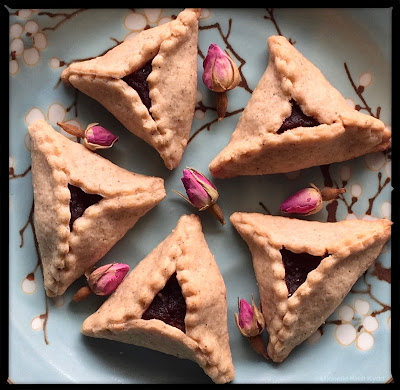
Baking with Flavor: Spiced Rose Hamantaschen
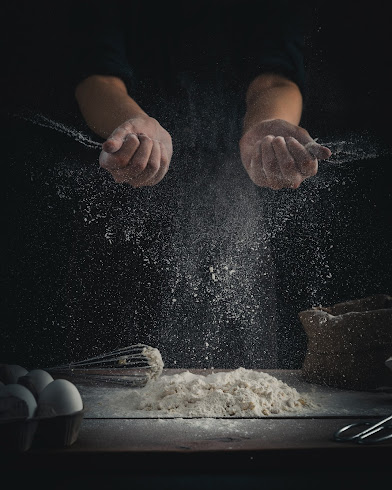
- 2 cups unbleached, all-purpose flour (sifted)*
- 2 tsp double-acting baking powder (aluminum-free)
- 1/4 tsp sea salt (fine ground)
- 3/4 cup granulated sugar
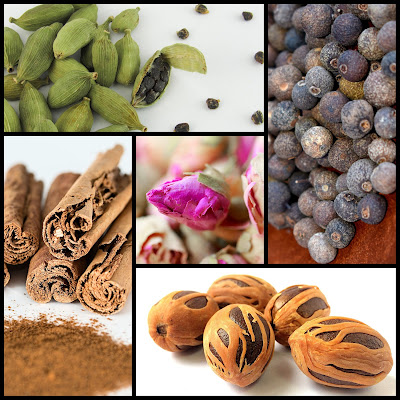
- 2 tsp Pereg Mixed Spices for Koobah
- 1 stick of cold, unsalted butter
- 1 large egg
- 1 tsp almond extract
- 1 tsp Eden Botanicals Organic Rose Hydrosol (or 1/4 tsp of a commercial brand like Cortas as it's very strong)
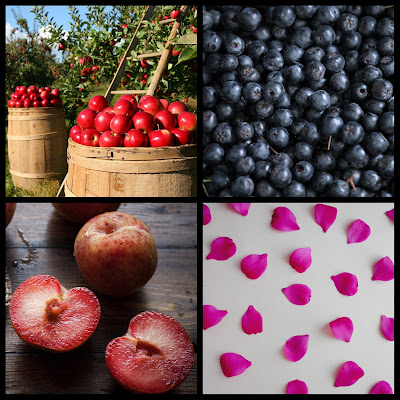
- 1 jar of Cracovia Rose Hip Lekvar
- Sift the flour, baking powder, salt, sugar and Koobah spice into a large mixing bowl.
- In a small bowl, beat the egg with almond extract and rosewater. Set aside.
- Cut the stick of butter into small cubes by cutting horizontally, then vertically. Add cubed butter to the dry ingredients and coat them. Press the cubed pieces of butter flat to form petals. Combine the butter petals with the dry ingredients until the mixture resembles coarse crumbs.
- Make a well in the center of the bowl with the dry ingredients and add the wet ingredients. Mix the dough with your hands until it is completely moistened. Gently work it in the bowl and form a single mound of dough that holds together well (it will feel less cohesive than typical cookie dough, which changes after refrigeration).
- Separate the single mound into two mounds of equal weight. Wrap each one in plastic wrap and place them side by side in a gallon-sized plastic bag with a zip seal. Refrigerate the dough overnight for a minimum of six hours to a maximum of 18 hours (longer is better for flavor).
- Line two cookie trays with parchment paper when the dough is ready to use. Set aside.
- Work with one half of a mound of refrigerated dough at a time, keeping the other half refrigerated.
- Roll the dough into an even 1/8-inch thickness on a pastry mat, working quickly as the dough tends to be sticky (short quick rolling helps).
- Cut the dough into rounds with a plain or scalloped 3-inch cookie cutter. You’ll fill the dough and shape it after you cut 7 rounds. (Each half a pastry mound yields approximately 7 cookies).
- Move the rounds to a parchment-lined cookie sheet using a long confection spatula (a small, flat silicone cookie spatula will also work as it's flexible).
- Scoop a teaspoon of the filling using a one-teaspoon measuring spoon, removing the excess filling from the bottom of the measuring spoon (a form of leveling) and adding the excess filling back into the jar.
- Place the leveled filling into the center of each round using an additional spoon to scoop it out.
- Make a triangle shape by folding up two sides of the dough (each side is equivalent to a third of the circle) and pinch the corners together where they meet.
- Fold up the third side and pinch together at both sides, forming a triangle and leaving an opening at the top (don't close the center). The filling should be just above the top of the pastry.
- Continue rolling, cutting, filling and shaping the dough rounds until you've finished using all of the refrigerated dough.
- Adjust the arrangement of hamantaschen so that each one is 1 1/2 inches apart (1 inch for cookies made with a 2 3/4 inch pastry cutter) when you're done. Take advantage of the geometry of the cookie, as triangular shapes can be placed at different angles without touching while baking.
- Divide the oven racks into thirds and preheat the oven to 375 degrees.
- Bake for 12 minutes, reversing sheets from top to bottom and back to front after the first 6 minutes. The cookies should be barely colored on the sides, slightly darker on the edges. Add 1-2 minutes if needed, based on the temperament of your oven.
- Move the baked hamantaschen to cooling racks and allow them to them cool completely. Store them in an airtight container between layers of parchment paper for 24 hours before eating. The resting period allows the flavors to meld.
Wednesday, February 2, 2022
Scent in Film: Rebellion of the Flowers
Rebellion of the Flowers (1992, Millie Goldsholl) from Chicago Film Archives on Vimeo.
Rebellion of the Flowers begins with the efforts of a farmer named Jan, who thoughtfully relates to working the land and growing a plot of flowers from seed. His relationship to the flowers is infused with spiritual reverence and humility, embracing the interdependent relationship between nature, the elements, and the work of human hands until something goes awry, and the essence of tyranny invades his gentle spirit.
Jealousy skews Jan's perspective as he becomes enraged by the biological inclination of flowers to turn towards the sun, a plant behavior known as heliotropism. The once gentle tiller of earth becomes consumed by the possessive notion that his flowers are disobedient and should bend towards him in reverence for the life he gave them, conflating his role with that of the divine.
Once in a while he felt that in the sight of the flowers he was G-d...An implausible annoyance swept through Jan...His anger wished the sun out of the sky.
Farmer Jan is engorged with power and rage. His character is literally and figuratively consumed at the end of the film, but not without a touch of irony. Rebellion of the Flowers takes an interesting turn as an unnamed smell described as "a curious spice" appears in the story's resolution. Jan's body is drawn into the soil by tendrils in the flowerbed, where his body returns to the earth to nurture the plants he once gently tended.
The next morning the sun came out. The flowers were beautiful in their brilliant color and there was a curious spice mixed with the sweetness of their perfume.
A "curious spice" isn't a descriptor for the putrescence of bodily decay, which raises an olfactory question. What smell did Jan's body contribute to the earthbound flowers he raised? To answer this query one must sniff beyond the film's referenced scents of freshly turned soil, sprouting green seedlings and delightful flower scents.
My olfactory mind is informed by scentscapes in New York and Michigan, so I lean into encounters with wild sweet woodruff (Gallium odorata) in the Ann Arbor summer landscape. The plant's leaves possess an herbaceous, spicy and warm scent that intensifies when the leaves are dried. This is notable in sweet woodruff specimens found in herbariums.
Sweet woodruff dresses the air without usurping the aroma of other plants like an olfactory tyrant. This is how I imagine the aroma of a transformed and somewhat redeemed Jan, entombed in humus against the victorious scent of the flowers. Perhaps you have some ideas of your own, dear reader...
Notes & Curiosities:
Everyone possesses a unique compendium of aromatic experiences based on personal life experience. What does your olfactory mind reference when you watch Rebellion of the Flowers? Can you imagine what it would be like if you were a perfumer assigned to create a collection of four wearable scents inspired by scenes in Rebellion of the Flowers? There's a bevy of metaphors and literal interpretations worthy of exploration. What would you create?
Dried sweet woodruff is available from Mountain Rose Herbs. I made a perfume-grade tincture with them that reminds me of summer every time I smell the infusion on a perfume blotter. Feeling crafty? Aromatic sachets filled with a blend of lavender and sweet woodruff are also quite lovely, and easy to sew by hand.
The "sun" in the name sunflower is informed by heliotropism. So is the Latin word for the turnsole plant, which was called solsequium ("sun-follower") in herbals. Turnsole joined woad and indigo as vegetable-based pigments used by medieval manuscript illuminators. Solsequium would be a great name for a line of perfumes inspired by sun-warmed plants and medieval illuminated manuscripts. Take that to your imaginarium.
If you're familiar with the scent of morning-cut hay dried under a summer sun, or the creamy, sweet, vanilla, and nut-like nuances in sweetgrass, you’re acquainted with sweet woodruff's coumarin-scented kin. Coumarin repels pests that would otherwise make a feast of a plant as coumarin tastes bitter to them. Humans aren't bothered by the tastes of small amounts of coumarin, which is why they find May wine and tonka bean flavored desserts and confectionary appealing.
Need to know more about the science of coumarin? Read this research paper: Carneiro, Aitor, Maria J. Matos, Eugenio Uriarte, and Lourdes Santana. 2021. "Trending Topics on Coumarin and Its Derivatives in 2020" Molecules 26, no. 2: 501. https://doi.org/10.3390/molecules26020501
Image of whole and shaved tonka beans ©Michelle Krell Kydd. All rights reserved.